Posted on

How to Clean and Maintain Your Used Lens

Learn how to properly clean and maintain your used camera lenses. This guide covers essential tools, step-by-step cleaning methods, fungus prevention, and tips to keep your lenses in top condition.

How to Clean and Maintain Your Used Lens

Lenses are the heart of photography, and whether you’ve invested in a brand-new piece of glass or scored a bargain in the used market, proper cleaning and maintenance are key to keeping your gear in top condition. Used lenses, in particular, can accumulate dust, smudges, and even fungus if not cared for properly.

The good news? Cleaning and maintaining a used lens is simple with the right tools and techniques. Regular maintenance ensures optimal image quality, extends the lifespan of your equipment, and protects your investment.

In this guide, we’ll walk you through the best practices for cleaning and maintaining your used lenses, so you can enjoy clear, sharp images for years to come.


Why Proper Lens Care is Essential

Before diving into the how-to, let’s understand why lens maintenance matters:

  • Image Quality: Dust, fingerprints, and smudges can reduce contrast, introduce flares, and soften your images.
  • Longevity: Proper care prevents long-term damage such as fungus growth or mechanical wear.
  • Resale Value: A well-maintained lens retains its value better if you plan to resell it later.
  • Reliability: Clean, smoothly functioning lenses reduce the chance of missed shots due to mechanical issues.

Essential Tools for Lens Cleaning

To clean and maintain your used lenses effectively, you’ll need a few basic tools:

  1. Rocket Blower: For removing loose dust and debris.
  2. Soft Lens Brush: Helps dislodge stubborn particles gently.
  3. Microfiber Cleaning Cloth: For cleaning the lens glass without scratching.
  4. Lens Cleaning Solution: Specifically designed to clean optics safely.
  5. Lens Cleaning Tissues or Wipes: Pre-moistened or dry tissues for single-use cleaning.
  6. Lens Pen: Features a soft brush on one end and a cleaning tip on the other.
  7. UV/Protective Filter (Optional): Acts as a shield to protect the front element of your lens from dust and scratches.

Step-by-Step Guide to Cleaning a Used Lens

Step 1: Use a Rocket Blower

  • Start by holding the lens upside down.
  • Squeeze the blower to blow off loose dust and particles from the lens surface.
  • Focus on both the front and rear lens elements.

Tip: Never use compressed air cans as they can spray propellant and damage your lens.


Step 2: Brush Away Remaining Dust

  • Use a soft lens brush to gently sweep away dust that the blower couldn’t remove.
  • Make light, circular motions without applying pressure.

Step 3: Wipe with a Microfiber Cloth

  • Inspect the lens under a light source for smudges or fingerprints.
  • Using a clean microfiber cloth, wipe in gentle circular motions starting from the center of the glass outward.
  • Avoid using T-shirts, tissues, or paper towels as they can scratch the lens coating.

Step 4: Use Lens Cleaning Solution for Stubborn Marks

  • Apply a drop or two of lens cleaning solution to a microfiber cloth or lens tissue (never directly onto the lens).
  • Gently clean the glass surface with a circular motion.
  • Immediately wipe with a dry section of the cloth to prevent streaks.

Step 5: Clean the Lens Barrel

  • Use a slightly damp microfiber cloth to clean the exterior barrel of the lens.
  • Pay attention to control rings (zoom/focus) and seams where dust tends to accumulate.
  • If necessary, use a soft brush to clean textured areas or engraved markings.

Step 6: Inspect the Rear Element and Mount

  • Repeat steps 1–4 for the rear lens element.
  • Carefully clean the lens mount area to ensure a good connection with your camera body.

Step 7: Use a Lens Pen for Final Touches

  • Use the brush side to remove fine dust.
  • The carbon tip can be used for gentle, streak-free cleaning of any remaining smudges.

Preventative Maintenance Tips for Used Lenses

1. Always Use Lens Caps

  • Keep the front and rear lens caps on when not in use.
  • Caps protect against dust, scratches, and accidental knocks.

2. Store Lenses in a Dry, Clean Environment

  • Store lenses in a dry box or with silica gel packets to prevent moisture buildup.
  • Avoid leaving lenses in humid places to reduce the risk of fungus.

3. Avoid Touching Lens Elements

  • Handle the lens by its barrel, not the glass.
  • Finger oils can degrade lens coatings over time if not cleaned properly.

4. Use UV or Protective Filters

  • A UV filter acts as a sacrificial layer to protect the front element.
  • While it may slightly affect image quality, it’s a cheap layer of defense against scratches and dust.

5. Keep Lenses Away from Harsh Environments

  • If shooting in dusty, sandy, or wet environments, use lens hoods and weather-sealed accessories when possible.
  • Clean the lens immediately after exposure to harsh elements.

How to Deal with Lens Fungus

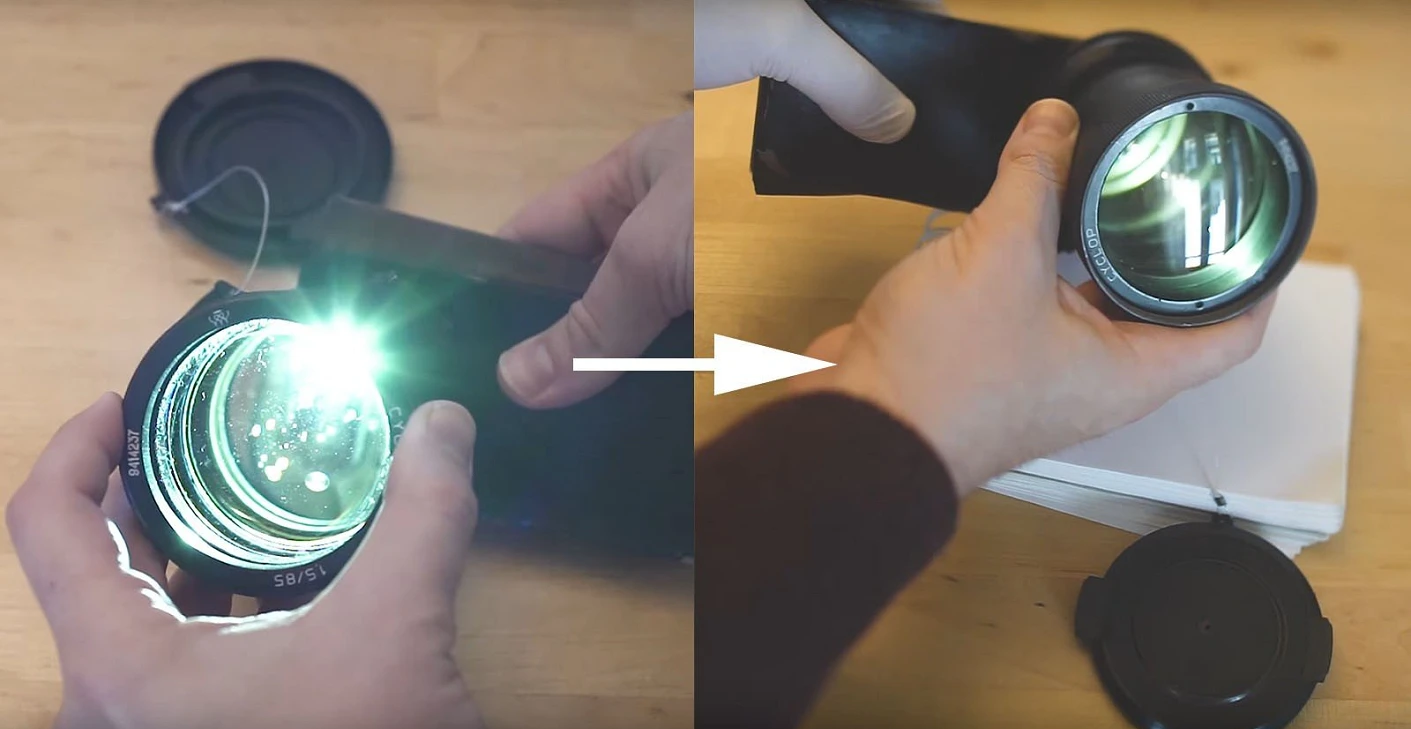
Fungus is a common issue in older or poorly stored lenses. If you spot faint cobweb-like patterns inside the lens glass, that’s a sign of fungal growth. Here’s what you can do:

  • Isolate the Lens: Keep it away from other gear to prevent contamination.
  • Expose to UV Light: Sunlight can help kill fungus but won’t remove damage already caused.
  • Professional Cleaning: For internal fungus, it’s best to send the lens to a professional repair technician.

How Often Should You Clean Your Lens?

  • Front and Rear Elements: Clean whenever you notice dust, smudges, or fingerprints.
  • Lens Barrel: Wipe down every few weeks or after shooting in dusty/wet environments.
  • Deep Clean: Every few months, give your lens a thorough clean, especially if used regularly outdoors.

Signs Your Lens Needs Maintenance

  • Smudges, streaks, or dust spots showing up in photos.
  • Grinding noise or stiffness in zoom/focus rings.
  • Visible mold/fungus growth inside.
  • Loose lens mount or rattling sounds.
    If any of these occur, address them promptly to avoid long-term damage.

When to Seek Professional Servicing

Some issues are best left to the pros:

  • Internal Dust or Fungus: Requires disassembly to clean.
  • AF/MF Mechanical Issues: If the autofocus becomes sluggish or manual focus feels rough.
  • Aperture Blade Problems: Sticky or slow-moving aperture blades need professional attention.
    Regular professional servicing can extend the life of high-end lenses significantly.

Conclusion

Cleaning and maintaining your used lenses is an essential habit for every photographer. With the right tools and simple routines, you can ensure that your lenses stay in top optical and mechanical condition, delivering sharp, high-quality images for years to come.

Whether you own a vintage manual focus gem or a modern autofocus workhorse, consistent care prevents costly repairs and keeps your photography gear performing at its best. Remember: a clean lens is a happy lens, and your images will thank you for it.

Posted on

Sony-D Lenses

The short answer – Sony-D lenses are Sony-A lenses that have Advanced Distance Integration. D lenses have 8 contacts, non-D lenses have 5 contacts.

Buying Sony lenses could be confusing. So before I go straight to the explanation of what is Sony-D, I will explain the main differences and the evolution of the Sony lenses.

Sony produces cameras with two lens mount systems: E-mount and A-mount. E-mount is used on mirrorless camera bodies. While A-mount lenses are for the standard Sony unique Translucent Mirror type camera bodies. Yet, using the Sony lens adaptors like LA-EA1, LA-EA2, LA-EA3 or LA-EA4, A-mount lenses can also be used effortlessly on E-mount cameras.

The A-mount was originally Konica Minolta A-mount camera system, which is now used with Sony. Sony A-mount  lenses are optically, mechanically and electrically identical to their Minolta predecessors Therefore, all Minolta AF (i.e. Minolta a-mount) lenses from Minolta are compatible with Sony alpha cameras. The older Minolta lenses for film cameras could be used on modern Digital SLR cameras.

The list of existing Sony A-mount lenses on Wikipedia.

Sony-A mount lenses in our web shop.

Also, could be confusing that the Sony-A mount is also called Sony α (the lower case to Greek letter alpha, often transliterated as Sony Alpha). To make it more complicated, Sony has caused even more confusion. Before, if the camera was an Alpha, it had an A-mount or alpha mount. If it was a Nex camera, it had an E-mount. Sony has come out with Alpha E-mount cameras. So it is good to be aware that not all Alpha cameras have Sony-A mount. If the camera says E-mount, it is not compatible with Minolta (and Sony-A) lenses without the Fotodiox lens mount adaptor. This found this website very useful when it comes to lens and camera compatibility.

Of course, as like many other models the Sony lenses are also going through transformation and development. The old Minolta lenses are not all D lenses, while most modern Sony-A lenses are all D lenses. You can quickly tell if a lens is a D lens or not by counting the number of contacts on the lens mount. D lenses have 8 contacts, non-D lenses have 5.

I have collected here some of the best explanations from different forums that explain why Sony-D lenses are better than non-D lenses:

” That doesn’t have anything to do with the ‘D’ designation. In Minolta/Sony ‘talk’ the ‘D’ indicates that the lens has the ‘D’ chip, which gives distance information to the body. You’re thinking that the ‘D’ means that the lens is optimized for digital cameras. However, as Minolta used the ‘D’ before digital came out.”

“Sony now uses the term “distance encoder” in its lens descriptions, which as far as I know means the same thing as “Advanced Distance Integration” (ADI). Personally, I’ve never noticed that using ADI makes much difference in results.”

“The Minolta 24-105mm f3.5-4.5 (D) Lens was one of the first lenses with ADI (Advanced 
Distance Integration) flash metering system. The D indicates Distance integration”

“Sony-D-compatible” means the lens has 8 electrical contacts rather than 5 which allows additional data to be exchanged between camera body and lens, and that the lens sends focus distance information back to the body. The body can use the distance information to adjust the flash output if you select ADI flash mode. 8 pin lenses started appearing with the Minolta xi range (about 1993, I think), but ADI only came in about 2000 (with the Minolta 5/7/9 series cameras). Many treasured legacy lenses (e.g. the Beercan) are only 5 pin, and even today some current lenses are still only 5 pin, e.g. the excellent Tokina 11-16/2.8.”

” The ‘D’ function was originally designed by Minolta to help with flash exposures when the subject was against a reflective background. The ‘D’ lenses were designed to work with the 5600HS D flash, and a body that was able read the ‘D’ distance information.

“This is how it works: Suppose you wanted to take a picture of a subject standing 10′ in front of you. Two feet behind the subject is a highly reflective surface. Normally, if you try and take a picture in this type of situation, the picture would come out with the subject being underexposed. This is because the light from the flash bouncing back from not only the subject, but the reflective background. Because of this strong reflection, the light output from the flash would be cut off before the subject is properly illuminated.”

“With the ‘D’ system in place, the camera would know that you are focusing on a subject ten feet in front of you. Therefore the reflection from the background would be disregarded, as it is further away from your focused point. If you were to shift focus to the reflective background, then the camera would then measure the light from the reflective background and not the darker foreground.”

“I believe every Minolta/Sony DSLR from the Maxxum 9 could take advantage of the ‘D’ chipped lenses and ‘D’ flashes. I’m not sure if Sony was found other uses for the distance information in the newer cameras.”

Posted on

The Differences between Snappers and Photographers

On the one hand, this article is not intended to be a doctrine set in stone. On the other hand, it should be more about the technical details in photography that the snappers may not even know about, but which are valuable techniques for the careful photographer when it comes to the photographic implementation of an idea. What are the classic differences?

Table of Contents

•        My friend, the clicker

• The best image quality of a lens

•        Do not stop down too much: diffraction blur

•        Do not choose the ISO value too high

•        Use a tripod

•        Types of light in photography

•        Turn off the autofocus, avoid a blurry foreground

•        Correct exposure: expose on the shadows

• Use the measured value memory of the camera

•        Use the white balance correctly

• Distortions and Converging Lines

•        Use of artificial light

• Develop a concept

My friend, the snappers

The expression  “camera snappers” (following from the German designation of “knipster” means someone who just presses the shutter release without any great consideration), yet often pretend to be a “serious photographer”

I have a good friend who has been the owner of a modern digital single-lens reflex camera that is quite usable in terms of quality. Since the 1980s, such cameras have had a “P function” (automatic program) or, even better, an “auto function”. You don’t have to worry about anything anymore, the camera will fix it. At first I think that’s really good! Because how cumbersome is dealing with physics when you just want to make good pictures. The snappers have a clear advantage here. In detail, however – and by “detail” I mean looking at a large print and not the preview on a small screen and on the other hand reproducibility – you will not infrequently be able to detect certain technical errors that can be circumvented by mere specialist knowledge. Specialist knowledge, which, for example, do not acquire professional photographers for free and initially spend a lot of time on a certain degree. There are some classic differences here with regard to the operation of the photographic apparatus.

In any case, my friend, the snappers, works as follows: He points his camera at the subject and looks at the display of his digital camera via live view. Now he turns any cogs until the displayed “live image” appears as he imagines it and then clicks. When I observe this way of working, the hair on the back of my neck easily stands on end. It’s almost as if a cook simply added sugar to the pot if the finger test was too salty. Concretely screwing maybe if there is an insufficient shadow drawing (I don’t think he knows what this is) he simply high the ISO value or opens the aperture without being aware of the consequences. If he is happy with it – very much! I certainly don’t want to take the fun away from him. But there is another way. And with a view to reproducibility and attention to detail, you should know a few basic things about photography:

The best image quality of a lens depends on you

A lens is a light collector: a lens system absorbs all the ambient light that it “sees” and bundles it into a focal point. The aperture can be used to “sort out” the area of ​​the light rays that hit the technically most unfavorable surfaces of the lenses – and these are their outer areas. Consequently, you should go for the best possible picture dim.

Every lens achieves the best image quality technically if it is stopped down by two to three values ​​(English “stops”). A stop is a doubling or halving of the amount of light let in when taking a photo.

For the most precise representation you should use a lens whose light intensity 1: 2 is stopping down to approx. F / 5.6, provided that you do not get into trouble with too high a depth of field or too long an exposure time, if the ambient light is already too dark for a correct exposure or if there is blurring threatens (here the photographer naturally uses a tripod).

Especially zoom lenses and especially the cheap “kit lenses” I would always stop down by at least two f-stops. However, high-quality and correspondingly expensive lenses often leave no questions asked when it comes to precise imaging performance in the corners of the image and with a 100% crop view.

My friend, the snappers, will never know at which aperture he is taking pictures. However, consciously working photographers know that, on the one hand, they naturally control the depth of field with the aperture (this is well known even under snaps) and, on the other hand, they can use the maximum image quality of their lens.

Do not stop down too much: diffraction blurs

However, if you stop down too far, a phenomenon called “diffraction blur” occurs in full format do not stop down to aperture 22, because here the aperture is already closed so far that the incoming light has to squeeze through the aperture blades – like through the doors of a Japanese subway or just bends over: There is a uniform blurring. So this is where  dog chasing its tail. Photographs can supposedly depict all the details from front to back, but there is the problem of diffraction blur. On a 30 × 40 cm print, such images will lack a certain degree of sharpness, whereas everything still looked okay on the small laptop screen. If necessary, I stop the lens of my crop DSLR camera (smaller sensor than the full format) down to a maximum of f/11. Then there is a visible diffraction blur.

Do not choose the ISO value too high

Digital cameras have a notable advantage over analog cameras: You can adjust the ISO value (i.e. the sensitivity) for each picture. With an analog camera, this can only be changed by changing the type of film (i.e. by inserting a different film).

Basically, the lower the ISO value, the finer the detail will be. I myself always work at 100 ISO whenever possible. This is how I achieve the maximum image quality in this regard. Above I briefly mentioned the auto function of the digital camera. In this mode there is no way to intervene with regard to the two factors influencing image quality, aperture and ISO value. The best imaging quality is obtained by choosing the lowest possible ISO value and stopping down the lens by about three f-stops.

Use a tripod

I just mentioned the tripod briefly. I almost always use such a device as long as I can transport my tripod according to the situation, because:

Every photo from the hand is blurred – the only question is whether you can still see it.

Imagine you are exposing at a fast shutter speed (exposure time) of 1/250 second. It is really a very short moment. Do you think you can shoot such pictures out of your hand with confidence? Maybe nothing seems to be blurred because the photos are all sharply focused on the small display of the digital camera. Yet, this is a mistake mistake! Because even within this 1/250 second there is hand movement while taking the picture, even if only a slight one. But the more you enlarge the corresponding images, the more you enlarge even the smallest of blurring – and at some point they become visible. However, I want maximum quality and therefore always use a tripod if possible, even with the short exposure times. Even a simple cord tripod can increase the sharpness of the images.

Imagine you are photographing a big balloon: This picture has no so-called “edges”. It will also be shown in focus with a very slight blurring.
However, photograph a single hair and enlarge it to 18 × 24 cm Even a minimal motion blur will affect the image sharpness. Because the edge of the hair will only be shown sharply by using a tripod, because the camera must be positioned absolutely rigid for an optimal result.

This is one of the reasons (maximum sharpness) why some photographers look wander even in broad daylight with heavy tripod-monsters. While on the snappers shoulder a full-format camera swings on their shoulders to their hand and simply again in auto mode clicks are made, without having to think too much.

Of course, such a tripod is also mandatory for a very conscious image composition that is well thought out to the millimeter, as well as for the absolutely vertical alignment of the camera in order to avoid falling lines (see a little further below).

Types of light in photography

The most important factor in photography is – the light. No, it’s not the camera, not the lens. Just imagine: A hundred years ago, carpenters built cameras, not technology companies. These people had little knowledge of photography (because they mainly dealt with tables and massive cupboards): They only had to make light-tight wooden boxes with gear screws and leather bellows. These were very simple devices. Why are we still fascinated by the pictures that were made with such anachronisms? Certainly: there is some romance when looking at these pictures. However, at that time the photographers knew how to concentrate on the most essential thing in photography: the light. (Because quite a few came from academic painting,

No camera can vary the character of light.

Light exists in many different ways. Now imagine you want to photograph a woolen sweater under an overcast sky: The image will clearly show such a piece of clothing. Now the sky breaks up and the sun comes out: This sun alone creates a prompt hard light: Suddenly every fibre of the sweater becomes visible! Consider the following picture:

 
The snappers simply take photos. The consciously acting photographer only takes photos when the light is favorable according to his imagination – if of course possible. I myself have often returned home frustrated when suddenly bright sunshine prevailed, when I needed a very diffuse and uniformly illuminating one of my plan. Here I wanted to be professional and prefer not to take a picture at all than one that did not meet my expectations. How good it is for the snappers in their modesty.

Turn off the autofocus, avoid a blurry foreground

A particularly noticeable mistake is the ignored foreground. I allow myself to speak of a mistake at this point. Because it can of course also be the case that this should be deliberately set. The snappers focus on the subject. The consciously acting photographer, on the other hand, thinks about from where to, where the focus area should extend and deliberately adjusts the focus point and aperture accordingly. Most of the time this cannot be done automatically.

Correct exposure: expose for the shadows

There is a phrase: Expose on the shadows. Develop according to the lights. This means: Give the camera enough light so that even the darkest picture elements still show detail, but make sure that the brightest picture elements do not appear “eroded” and pure white.

My buddy, the snappers, doesn’t pay attention to anything like that, because he looks at his subject (on the small screen) globally. However, he risks that, for example, the shadows under the trees in the background of his subject lose their richness of detail, because he relies on the simple exposure metering on his digital camera. The result: monotonous black surfaces. A purely technically well-made photography is alive on the other hand, from shades  creates the impression of three-dimensionality. Therefore, one should expose in such a way that even the darkest areas of the image still have a hint of drawing (visual arguments e.g. From Anders Petersen, however, prove the opposite). I myself work basically by constantly looking at the camera’s histogram and checking the brightness of the image. So I also look at my photographs locally (in details and not globally).

The most important control tool of a DSLR: the histogram . Based on this, I can see whether all areas in the subject still have drawings. This can hardly be read correctly from a preview image on the small display of the digital camera, especially not in bright ambient light.

Use the measured value memory of the camera

I prefer to take photos in mode “A” (or AV with Canon): Here I preselect the aperture and the camera automatically determines the “correct” exposure time. It usually does this quite well – thanks to “matrix measurement”. For subjects with a high proportion of very bright areas, however, even the most intelligent metering method tends to be underexposed.

Use the white balance correctly

Often the so-called white balance is set to “Auto”. That’s a good thing, because in most cases the colors are reproduced realistically

Distortions and Converging Lines

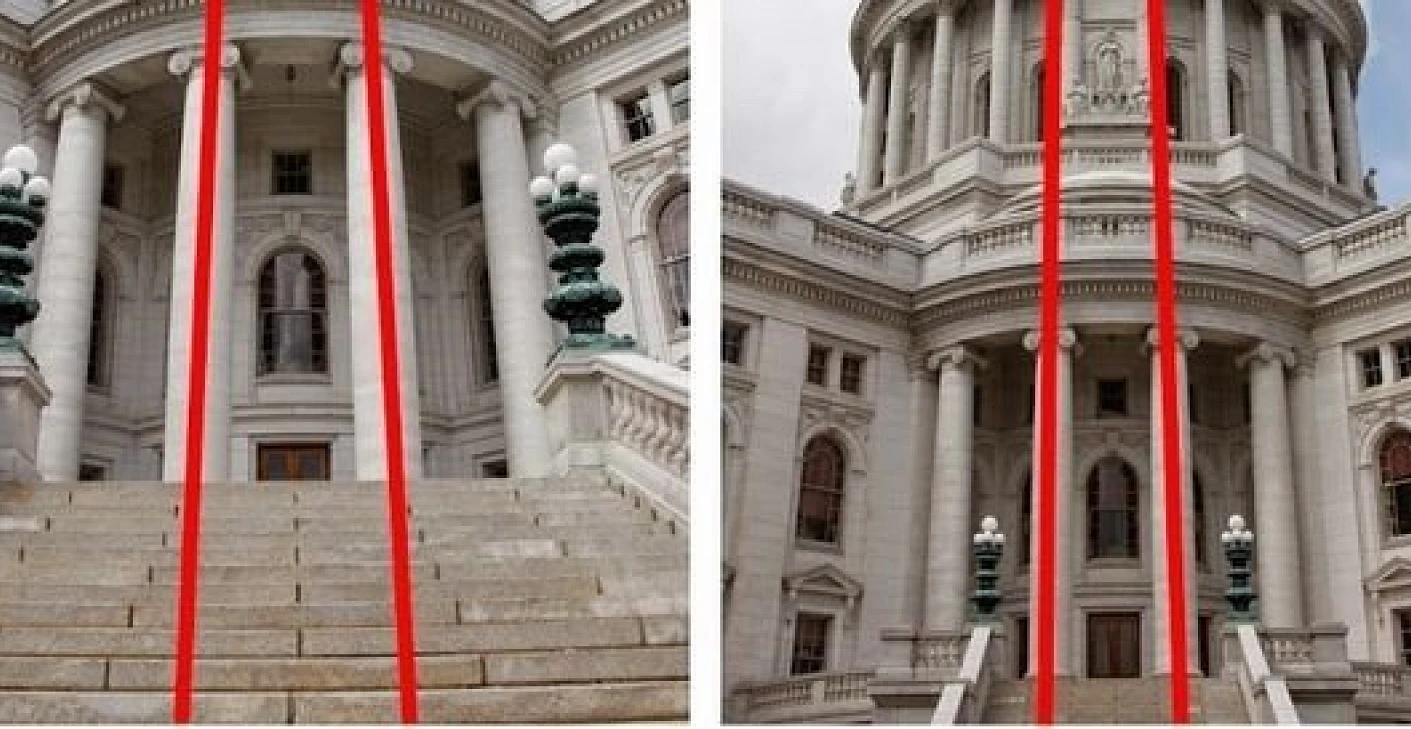
This point is mostly only relevant when taking pictures of houses or tall buildings. What photographers know: If you move the camera out of the absolutely vertical position, all vertical lines (e.g. buildings) narrow upwards. In concrete terms, this means: Buildings are depicted like houses of cards that appear to tilt backwards.  There are two remedies: On the one hand, you can of course use a real shift lens. On the other hand, the photo can be later be rectified on the computer with image processing. Here, however, there is a problem: The rectification on the computer is always accompanied by a certain amount of cropping. So you lose a bit of resolution. You have to take this crop into account when taking the picture and consequently move a little further away from the subject or use a slightly shorter focal length or zoom setting of the lens so that you will have enough margin on the photo, which later has to be partially cut off again.

The photos of “snappers” are often marked by restlessness, which is expressed by converging lines, careless areas of blur and unfavorable light.

Use of artificial light

Even with the built-in flash, you can skillfully create subtle effects.

Flash units seem to be rather inconvenient for most snappers. They are only used as an emergency solution if it is too dark and a flash would destroy the natural light mood of the picture. That’s true at first, but only if you don’t know how to deal with it.

Have you ever wondered why a dedicated wedding photographer wouldn’t want to part with his flash on the camera even in the most beautiful sunshine? It’s bright enough here. Correct. However, the wedding photographer does not use artificial light as the primary light source (this remains the sun). He uses the flash as a so-called fill light or “fill flash”.
Because what does the sun cause? Well shadow! The high-lying sun creates dark shadows under people’s eyes and creates high and disturbing contrasts within clothing. With a flash, however, such shadows can easily be brightened in such a way that the inexperienced viewer does not even notice that an additional flash has been used. The flash unit also creates a slight brightening effect (people stand out slightly from the background) and a so-called “catch light” in the eyes (a sparkle). The photographer almost always uses a simple clip-on flash, but its light output is somewhat more subtle. As a result, he easily gets exempted people. This effect is not noticeable as “over-flashed”, but provides a certain brilliance in the foreground (well, sometimes it doesn’t quite succeed).

It is clear that the intensity of the additional artificial light source must never be set too high for this! Otherwise it will look as if portrayed people are standing in front of a photo wallpaper.

Develop a concept

So far, I’ve only ever written about techniques with which the tool (the camera) can be operated precisely so that the image results can exactly match the ideas.
But what kind of ideas do you have about photography? An elementary component of “conscious” photography is to think about it beforehand (instead of just snapping around wildly). I often work in series. So I dedicate myself to a very specific topic with my pictures and always prepare the pictures with this idea in mind. Of course, it is important to me that the parameters (a type of light, depth of field, color saturation …) remain the same as possible for all individual photographs. So I keep my handwriting, so to speak at and don’t change anything here.
The photographic topic itself is a broad field: You can deal with documentaries or with a certain milieu, with landscape shots at a very specific time of the day, with interior portraits, etc. The only important thing here is that you don’t snap randomly.

Posted on

Fixed focal length vs. Zoom?

I often get the question what is actually better now, I would like to explain the difference between fixed focal lengths and zoom lenses. Neither of the two is really better, it depends on what you want to photograph.

Zoom lens

A zoom lens makes life a lot easier for the photographer. We can easily zoom in on objects without moving. Of course, this zoom mechanism needs space. The lenses in the lens have to be able to move and this is usually at the expense of lens performance.

Disadvantages of the zoom lens

Due to the zoom mechanism, the lens is missing in other places. Most zoom lenses are very limited in terms of aperture . That is of course logical. The space that the zoom takes up in the lens is at the expense of the other elements. In the affordable price range, the lenses have a maximum open aperture of 3.5 – 6.3. It all depends on the lens and the zoom level.

Advantage of the zoom lens

Of course, the number one advantage is zooming. You don’t have to change the lens if you want a different focal length . However, this can quickly become a disadvantage. I’ve learned more from prime lenses than I could ever have learned from a zoom lens. You think a lot more about the point of view and the perspective and don’t just zoom in on your subject.

Prime lenses

A fixed focal length is a lens without a zoom function. I cannot change the focal length of the lens and have to walk to get closer to my subject.

Advantages of the prime lens

Of course, the lack of a zoom saves space. This space can be used for a large aperture or to make a lens smaller and more manageable. Fixed focal lengths already offer open apertures of 1.8 in a lower price segment.

Disadvantages of the prime lens

The photographer has to think & move. He has no possibility to zoom but can only change the image section by moving (sneaker zoom).

I don’t really see that as a disadvantage myself. It has boosted my creativity enormously and fundamentally changed my thinking in photography.

Conclusion

My recommendation: Get a fixed focal length and only force yourself to take pictures with this for a certain time. It will give you a whole new view of things. You will know when you need a prime lens and when you don’t. You will think differently and adjust your point of view and perspective on the prime lens. You learn to take photos in a completely different way and don’t just zoom in on the subject lazily.

Posted on

Used Canon EOS 7D Mark II Review: Still a Pro-Level APS-C Beast?

Discover why the Canon EOS 7D Mark II remains a top choice in 2025. This in-depth review explores its performance, image quality, autofocus, video features, and value as a used APS-C DSLR.

Used Canon EOS 7D Mark II Review: Still a Pro-Level APS-C Beast?

Introduction
When it launched, the Canon EOS 7D Mark II was hailed as a professional-grade APS-C DSLR built for speed, durability, and performance. A favorite among sports, wildlife, and action photographers, this camera earned a solid reputation for its fast burst rate, advanced autofocus, and rugged build. But is it still worth buying in 2025—especially as a used option in the mirrorless era? Let’s dive into a detailed review to see if the 7D Mark II still holds its place as a pro-level APS-C beast.


1. Build Quality and Design

The Canon 7D Mark II was built like a tank. With a magnesium alloy body and weather-sealed construction, it’s designed to withstand harsh conditions—from rain-soaked football fields to dusty safari trips. Even in 2025, this durability makes it a reliable choice for those who shoot in challenging environments.

The layout is distinctly Canon: intuitive, well-spaced buttons, dual card slots (CF and SD), and a large top LCD screen. It handles more like a flagship camera than a mid-tier one, which is part of its continued appeal.


2. Autofocus and Performance

The autofocus system is still highly capable. With 65 cross-type AF points, the 7D Mark II provides excellent subject tracking and fast acquisition, especially when paired with high-quality lenses. While not on par with the latest mirrorless eye-tracking systems, it still performs better than most DSLRs in its class.

Its burst shooting rate of 10 frames per second, combined with a deep buffer, makes it ideal for action, wildlife, and sports photography—genres where timing and precision are everything.


3. Image Quality and Sensor

Equipped with a 20.2MP APS-C CMOS sensor and Dual DIGIC 6 processors, the 7D Mark II delivers excellent image quality. It handles ISO settings up to 16,000 natively (expandable to 51,200), and performs respectably in low light. While newer sensors offer better dynamic range and noise control, this camera’s files are still sharp, detailed, and easily editable in post.

Paired with good glass, such as Canon’s EF 70-200mm f/2.8L or a sharp prime like the EF 50mm f/1.4, it still holds its ground.


4. Video Capabilities

For video users, the 7D Mark II offers Full HD (1080p) recording at 60fps. It includes headphone and microphone jacks, manual audio control, and clean HDMI out. However, it lacks 4K and features like focus peaking or in-body stabilization (IBIS), which many newer mirrorless cameras provide.

If video is your priority, you might be better served by a newer hybrid mirrorless model like the Canon EOS R7 or even a used EOS 90D. But for casual video use, the 7D Mark II is more than capable.


5. Compatibility with EF Lenses

One of the major strengths of the 7D Mark II is its compatibility with Canon’s extensive EF and EF-S lens lineup. With so many high-quality used lenses on the market, you can build a solid, professional system for a fraction of the original cost. From telephoto zooms to fast primes, the options are plentiful and often very affordable second-hand.


6. How It Holds Up in 2025

So, how does the Canon 7D Mark II compare in 2025? Here’s a quick look at its pros and cons:

Pros:

  • Excellent build quality and durability
  • Fast, accurate autofocus
  • Impressive burst rate for action and wildlife
  • Dual card slots and pro-grade ergonomics
  • Wide range of compatible lenses

Cons:

  • No 4K video
  • No touchscreen or IBIS
  • Heavier than most modern mirrorless cameras
  • Aging sensor tech compared to 2025 standards

7. Price and Used Market Value

One of the biggest reasons to consider the 7D Mark II in 2025 is its price. You can typically find used models in excellent condition for $400–$600 USD. That’s a bargain for a rugged, professional-grade DSLR. If you already own EF lenses or are transitioning from an older Canon system, the 7D Mark II provides a budget-friendly yet capable upgrade.


8. Who Should Buy It?

The Canon EOS 7D Mark II still makes sense in 2025 for:

  • Wildlife and sports photographers on a budget
  • Existing Canon users with EF/EF-S lenses
  • Enthusiasts who value DSLR handling and durability
  • Photographers needing a backup or second body

However, if you’re starting from scratch and lean heavily toward video or want the latest features like IBIS, 4K, and eye-AF, then exploring Canon’s mirrorless R-series (like the R10 or R7) may be a better long-term investment.


Conclusion

The Canon EOS 7D Mark II may no longer be the latest and greatest, but it hasn’t lost its professional edge. As a used option in 2025, it remains one of the best pro-grade APS-C DSLRs you can buy for the price. If you prioritize speed, durability, and a robust lens ecosystem, the 7D Mark II still has plenty of life left in it. It’s not just nostalgia—it’s still a beast where it counts.

Posted on

Tamron vs Sigma: Which Used Third-Party Lenses Offer More Value?

Compare used Tamron and Sigma lenses to see which third-party brand offers better value in 2025. We break down image quality, build, autofocus, reliability, and price to help you choose the best used lens for your photography needs.

Tamron vs Sigma: Which Used Third-Party Lenses Offer More Value?

When it comes to third-party lenses, two names dominate the conversation: Tamron and Sigma. For decades, both brands have produced affordable alternatives to first-party glass (like Canon, Nikon, and Sony lenses), and in many cases, they’ve delivered results that match—or even surpass—the originals. But if you’re shopping the used market, which brand offers more value in 2025: Tamron or Sigma?

Whether you’re a professional looking to expand your lens collection or a hobbyist aiming to maximize your budget, this article breaks down how both brands compare in key areas like performance, build quality, compatibility, and long-term value—specifically from a used buyer’s perspective.


Why Consider Used Third-Party Lenses?

Before we dive into the comparison, it’s worth highlighting why buying used third-party lenses can be such a smart move:

  • Cost savings: Used lenses typically sell for 20–50% less than new ones.
  • Tried and tested: Well-reviewed lenses have years of real-world performance to back up their reputation.
  • Access to discontinued gems: Some older Tamron and Sigma lenses are no longer in production but still deliver excellent results.

Now, let’s get into the showdown.


1. Image Quality

Sigma: Art Series and Optical Innovation

Sigma’s Global Vision lineup—Art, Contemporary, and Sports—has elevated the brand’s reputation immensely. Their Art lenses in particular are known for superb optical performance, sharpness, and creamy bokeh.

  • Used gems: Sigma 35mm f/1.4 Art, Sigma 50mm f/1.4 Art, and 85mm f/1.4 Art
  • Strengths: Wide-open sharpness, minimal chromatic aberration, rich contrast

Tamron: Impressive Modern Optics at a Lower Price

Tamron has taken huge strides in optical quality, especially with its SP (Super Performance) and newer mirrorless-focused designs. Their VC (Vibration Compensation) and compact zooms have been praised for performance and portability.

  • Used standouts: Tamron 28-75mm f/2.8 Di III RXD (for Sony), Tamron 90mm f/2.8 Macro, 17-28mm f/2.8
  • Strengths: Solid sharpness, image stabilization, compact designs

Winner: Sigma, particularly for prime lenses. Sigma’s Art line often competes directly with OEM glass.


2. Build Quality

Sigma: Premium, Solid, Heavy

Sigma Art lenses are often built like tanks. They have a professional-grade feel with a hefty metal chassis. However, that also means they can be heavier than their counterparts.

  • Pros: Solid construction, premium feel
  • Cons: Larger and heavier, which may be a downside for travel or gimbal use

Tamron: Lightweight and Durable

Tamron leans into lighter, more compact designs. Many of their newer lenses use high-quality plastics that reduce weight without sacrificing durability. Tamron’s weather-sealing is also increasingly common on modern models.

  • Pros: Great for travel, often weather-sealed
  • Cons: Slightly less premium build on older models

Winner: Tie. If you want rugged build, Sigma wins. If you prioritize portability, Tamron has the edge.


3. Autofocus Performance

Sigma: Great on DSLRs, Hit-or-Miss on Mirrorless Without Updates

Sigma’s lenses generally perform well on DSLRs, but when used with mirrorless systems (especially via adapters), some older models may require firmware updates to maintain snappy and accurate AF.

  • Used caution: Be sure to check compatibility or update firmware when possible

Tamron: Consistently Quiet and Fast

Tamron’s recent lenses, especially for mirrorless (like Sony E-mount), feature quiet, accurate autofocus motors. They also adapt better to firmware updates and third-party compatibility.

Winner: Tamron, especially for mirrorless shooters buying used.


4. Lens Variety and Availability on the Used Market

Sigma: Prime Lens Powerhouse

Sigma dominates the third-party prime lens market, offering everything from 14mm to 135mm and beyond. If you’re looking for a fast, used f/1.4 lens, Sigma probably has a great one.

Tamron: Zoom Lens Specialist

Tamron has built a reputation on zoom lenses, particularly lightweight f/2.8 zooms for mirrorless systems. You’ll also find older Tamron zooms for Canon/Nikon DSLRs at bargain prices.

Winner: Depends on your needs

  • Go Sigma for used primes
  • Go Tamron for used zooms

5. Reliability and Warranty (Even Used)

Both brands offer excellent performance, but used lens buyers often worry about longevity. Here’s how each brand holds up:

Sigma

  • Art lenses are durable but complex internally—repairs can be expensive out-of-warranty
  • Used copies often retain value well due to popularity

Tamron

  • Tamron lenses are known to be dependable and less prone to issues like decentering
  • Many Tamron lenses come with longer warranties when new—something to ask about when buying used (some may be transferrable)

Winner: Slight edge to Tamron, especially for long-term reliability at a lower repair cost.


6. Price vs. Performance Ratio

Price is where used Tamron lenses really shine. You’ll often find similar focal lengths and apertures from Tamron at 15–25% cheaper than Sigma.

For example:

  • Used Tamron 24-70mm f/2.8 VC G2: ~$600
  • Used Sigma 24-70mm f/2.8 Art: ~$750–800

While Sigma might offer sharper corners or better build, Tamron often offers better overall value for budget-conscious buyers.

Winner: Tamron, for those looking to maximize performance per dollar.


Verdict: Which Brand Offers More Value Used?

CategoryWinner
Image Quality (Primes)Sigma
Build QualityTie
Autofocus (Mirrorless)Tamron
Zoom LensesTamron
Prime LensesSigma
Reliability/Repair CostTamron
Price/PerformanceTamron

Overall Winner: Tamron for Value, Sigma for Performance

If your goal is maximum value, especially on zoom lenses or lightweight mirrorless setups, used Tamron lenses are hard to beat. However, if you’re chasing ultimate image quality, especially in primes, used Sigma Art lenses still deliver flagship-level optics at a midrange price.


Final Buying Tips

  • Research lens compatibility with your camera system, especially for Sigma lenses via adapters
  • Check firmware update availability
  • Inspect carefully (or buy from a store offering return policies or warranties)
  • Ask about original warranty coverage—some lenses may still be under transferable manufacturer warranties

No matter which brand you choose, buying used Tamron or Sigma lenses is a smart way to stretch your photography budget without compromising on quality.

Posted on

Understanding Focal Length: A Guide for Lens Shoppers

Confused about focal lengths? This guide explains how focal length affects composition, perspective, and lens choices for photography. Learn which focal lengths suit portraits, landscapes, wildlife, and more.

Understanding Focal Length: A Guide for Lens Shoppers

When shopping for a new camera lens, one of the first specifications you’ll encounter is focal length. Numbers like 35mm, 50mm, 85mm, 70-200mm can seem confusing to beginners, but understanding focal length is essential for choosing the right lens for your photography needs.

Focal length affects more than just how “zoomed in” your photos appear. It influences composition, perspective, subject compression, and depth of field. Whether you’re capturing wide landscapes, portraits with creamy bokeh, or distant wildlife, choosing the right focal length makes all the difference.

In this guide, we’ll break down what focal length means, how it impacts your images, and help you understand which focal lengths are best suited for different photography genres.


What is Focal Length?

Focal length, measured in millimeters (mm), describes the distance between the lens’s optical center and the camera’s image sensor when the subject is in focus. It essentially determines how much of the scene will fit into your frame (angle of view) and how large your subject will appear (magnification).

  • Shorter focal lengths (wide-angle lenses) capture a broader field of view.
  • Longer focal lengths (telephoto lenses) provide a narrower field of view and magnify distant subjects.

Prime vs Zoom Lenses

Before diving into specific focal lengths, it’s important to understand the difference between:

  • Prime Lenses: Fixed focal length (e.g., 35mm, 50mm). Known for superior image quality and larger maximum apertures.
  • Zoom Lenses: Variable focal length (e.g., 24-70mm, 70-200mm). Offer flexibility in framing without changing lenses.

Focal Length Categories Explained

1. Ultra-Wide Angle (10-24mm)

  • Field of View: Extremely wide, often beyond what the human eye can see.
  • Best For: Architectural photography, expansive landscapes, interior shots.
  • Effects: Exaggerated perspective, making foreground elements appear larger.
  • Watch Out For: Distortion around edges, which can be used creatively or corrected in post-processing.

2. Wide Angle (24-35mm)

  • Field of View: Wide but less extreme than ultra-wide.
  • Best For: Street photography, environmental portraits, group shots, landscapes.
  • Effects: Allows you to capture more context in your frame while still maintaining manageable distortion levels.
  • 35mm is a favorite among street photographers for its natural, slightly wide perspective.

3. Standard/Normal (35-70mm)

  • Field of View: Closely matches human eye perception.
  • Best For: Everyday photography, portraits, street, and travel.
  • Effects: Balanced perspective; minimal distortion.
  • 50mm (Nifty Fifty) is the classic “go-to” prime lens for beginners due to its versatility and affordability.

4. Short Telephoto (85-135mm)

  • Field of View: Narrower, offering moderate subject compression.
  • Best For: Portrait photography, event shooting, detail shots.
  • Effects: Flattering perspective for portraits, with shallow depth of field and soft background blur (bokeh).
  • 85mm lenses are widely considered the “portrait king” for their flattering facial proportions.

5. Medium to Super Telephoto (200mm and beyond)

  • Field of View: Very narrow, focusing tightly on distant subjects.
  • Best For: Wildlife, sports, birding, and distant subjects.
  • Effects: Strong subject compression, allowing distant objects to appear closer. Excellent for isolating subjects.
  • 300mm-600mm lenses are essential for serious wildlife photographers.

How Sensor Size Affects Focal Length (Crop Factor)

Camera sensor size affects how a lens’s focal length behaves. Full-frame cameras have sensors equivalent to a 35mm film frame, while APS-C and Micro Four Thirds (MFT) cameras have smaller sensors, which effectively “crop” the image.

  • APS-C sensors typically have a 1.5x (Nikon/Sony/Fujifilm) or 1.6x (Canon) crop factor.
  • MFT sensors have a 2x crop factor.

Example:

  • A 50mm lens on a full-frame camera behaves like a 50mm.
  • The same 50mm lens on an APS-C camera gives an effective field of view similar to 75mm-80mm.
  • On an MFT camera, it behaves like a 100mm lens.

This means APS-C and MFT shooters get more “reach” with telephoto lenses but lose width with wide-angle lenses.


Choosing the Right Focal Length for Your Photography

Here’s a quick guide to help you choose focal lengths based on what you want to shoot:

Photography TypeRecommended Focal Lengths
Landscapes16-35mm (wide to ultra-wide)
Architecture/Interiors10-24mm (ultra-wide)
Street Photography28mm, 35mm, 50mm
Portraits (Headshots)85mm, 105mm, 135mm
Events & Weddings24-70mm, 70-200mm
Sports & Wildlife300mm, 400mm, 600mm
Macro Photography90mm, 100mm, 105mm macro lenses
Astrophotography14mm, 24mm (ultra-wide with f/2.8 or wider)

Prime vs Zoom for Focal Length Needs

  • Prime lenses (fixed focal length) often have wider apertures (f/1.2, f/1.4, f/1.8) which are great for low light and creating a shallow depth of field.
  • Zoom lenses (variable focal length) provide versatility, especially useful for dynamic situations where you can’t move physically closer or farther.

24-70mm f/2.8 zoom is considered an essential workhorse lens for event photographers, while 70-200mm f/2.8 zooms are staples for sports and wedding photographers.


Focal Length and Depth of Field (DoF)

Focal length affects how blurred the background appears:

  • Longer focal lengths (85mm and up) naturally compress the background and enhance background blur (bokeh).
  • Shorter focal lengths (24mm-35mm) provide a wider depth of field, keeping more of the scene in focus.

If you’re aiming for creamy bokeh in portraits, an 85mm f/1.8 will give you far better subject separation than a 35mm f/2.8.


Focal Length Perspective Compression

  • Wide-angle lenses (24mm and below) exaggerate the distance between subjects, making foreground objects appear much larger relative to the background.
  • Telephoto lenses (85mm and up) compress the scene, making the background appear closer to the subject, which is flattering for portraiture and useful in wildlife photography to make distant objects appear larger.

Do You Need to “Match” the Focal Length to Your Genre?

Not necessarily. Some photographers love breaking the “rules”:

  • Wide-angle portraits create an edgy, environmental look.
  • Telephoto street photography allows capturing candid moments from a distance.
    The focal length should match the look and feel you want, not just the genre.

Conclusion

Understanding focal length is key to making informed decisions when buying lenses. It’s not just about how “zoomed in” your photos are—it affects composition, subject isolation, background compression, and the entire mood of your images.

Whether you’re shooting with a full-frame DSLR, a crop-sensor mirrorless camera, or diving into vintage lenses, knowing how focal length impacts your photography will help you choose the right lens for the job. The right focal length equips you to tell your story the way you envision it.

When lens shopping, don’t focus solely on the numbers—consider how you want your images to look and feel, and choose focal lengths that match your creative vision.

Posted on

2020 TIPA Winning Cameras and Lenses

In Madrid The Technical Image Press Association(TIPA) announced the winners of the 2020 TIPA World Awards. What is TIPA?

The TIPA Award is widely regarded as one of the best known and most prestigious photography awards. . TIPA both recognise and honour industry companies and their products and serve as an important benchmark and guide for consumers in making their purchasing decisions.

Since 1991, the TIPA World Awards logos have shown which are the best photographic, video and imaging products each year. For over 25 years, the TIPA World Awards have been judged on quality, performance and value, making them the independent photo and imaging awards you can trust. I cooperation with the Camera Journal Press Club of Japan (www.tipa.com)

The TIPA jury is made up of the world’s best-known photography and imaging professionals.

2020 TIPA World Awards Process

Finalists are usually voted on at the TIPA general assembly by representatives from TIPA member magazines from around the world. The assembly was originally scheduled for mid-March in Las Vegas. However, when travel restrictions were established, the TIPA board implemented product recommendations and an online voting procedure for members globally.

Based on detailed tests and comparisons, a list of candidates and laureates are compiled.

List of 2020 TIPA winning products:

Cameras

  • Best DSLR Advanced Camera: Canon EOS 90D
  • The best DSLR Expert camera: Nikon D780
  • Best DSLR Professional Camera: Canon EOS-1DX Mark III
  • Best APS-C Advanced Camera: Nikon Z 50
  • Best APS-C Expert Camera: Sony A6600
  • Best APS-C Professional Camera: Fujifilm X-Pro 3
  • Best Full-Frame Expert Camera: Sigma fp
  • Best Full-Frame Professional Camera: Sony A7R IV
  • Best Full-Frame Photo / Video Camera: Panasonic Lumix DC-S1H
  • Best Medium Format Camera: Fujifilm GFX100

Lenses:

  • Best DSLR – Prime lens: Tamron SP 35mm f / 1.4 Di USD
  • The best DSLR macro lens: Laowa 100mm f / 2.8 2x Ultra Macro APO
  • Best DSLR – wide angle zoom lens: Tokina ATX-i 11-16mm f / 2.8 CF
  • The best DSLR – professional lens: Nikon AF-S Nikkor 120-300mm f / 2.8E FL ED SR VR
  • The best MFT lens: Panasonic Leica DG Vario-Summilux 10-25mm f / 1.7 ASPH
  • Best without mirror – Prime Standard lens: Nikkor Z 58mm f / 0.95 S Noct
  • The best mirrorless – wide-angle zoom lens: Sigma 14-24mm f / 2.8 DG DN Art
  • The best without mirror – Standard zoom lens: Sigma 24-70mm f / 2.8 DG DN Art
  • The best mirrorless – Telephoto zoom lens: Canon RF 70-200mm f / 2.8L IS USM
  • Best Professional Portrait Photo Lens: Canon RF 85mm f / 1.2L USM (DS)

Compact cameras

  • Best Expert compact camera: Sony RX100 VII
  • Best Vlogging compact camera: Canon PowerShot G7 X Mark III
  • Best Premium Compact Camera: Fujifilm X100V
Posted on

Shooting Action Shots in Low Light Conditions

I enjoy getting out to sporting events both indoors and outdoors with my digital electronic camera. Just recently I went to view tennis and took a couple of hundred shots over the day.

Recently I have been getting a few demands to please help with quick action shots inside your home. I remember when I too was frustrated with not having the ability to get a reaction from expert photographers about this situation. They were constantly so elusive with how they conducted themselves out on the field and what they did to get a certain result.

Now I’m going to tell you about how to master this. Do you want to hear the good news or the bad news?

Okay, the good news is that yes, it is possible. Bad news is that you do require a good electronic camera with manual controls to do it. Now because you have currently read this I am assuming that you have either a point and shoot camera or a DSLR. In either case, it’s better than an inexpensive electronic camera that does nothing.

Okay good, so we got that developed.

The trick is this: the factor fast action shots look blurred is generally because they are taken in level of low light, such as an indoor basketball arena for instance. What occurs is the electronic camera, if left on automobile, instantly changes itself to low light levels, which means a slower shutter speed. A slower shutter speed takes place the cam requires time to get in as much light as possible due to this low level of light. Its great from the electronic cameras point of view, but really, it’s annoying and frustrating.

So what can be done about it?

Well firstly, boost that shutter speed. You may observe a boost in digital sound however it will only be slight so do not worry about it. After all it’s most likely worth it for that ‘golden’ picture you are trying to get.

It’s going to be hard getting more light into the cam, since usually you’ll be too far for the flash to work properly anyhow. This is why your shutter is the very first factor to consider.

Something that might help further is this: Shot one, take the shutter at a specific speed, then shot the second, increase the shutter speed one notch, shot third time then increase it again, and so on and so forth. If you have the persistence and inclination, write down on a note pad exactly what shutter speed shot 1 was at, what shot 2 was at, and so on.

So unwind and deal with what you’ve got. Increase the shutter speed or increase the light.

Posted on

6 tips for creative photo ideas: the extraordinary from the ordinary

I really take pleasure in writing about imaginative motivation for new picture ideas. Specifically on the method to learn photography, it is constantly important to me that you don’t have to travel to a unique place to take excellent photos – rather the opposite. Just walk and find the wonder around you!

Content

– Discover the beauty in everyday life

– Discover the wonder around you

6 tips for more extraordinary in the ordinary

  1. The ordinary everyday life
  2. Observe light and shadow
  3. Take notice of the alignment
  4. Have fun with props
  5. Fascination in the background
  6. Take note of your corners and edges

Discover the beauty in daily life

It’s extremely delightful to take powerful, amazing images of everyday life. What can you do when you live in what you think is a truly dull place and you do not see any beauty in the everyday? The concern is of course not meant extremely seriously. Because it has to do with making something remarkable unusual. Let’s get going and try to find beauty in everyday life.

The reflection on a bonnet provides fantastic themes – and very simple to embed in scene.

Discover the wonder around you

It is a bit difficult not to wait for the big travel photography trip, but to discover the beauty – or at least the aesthetically spectacular fascination – in the everyday. But again and again I show you a lot of ideas that it is now very easy to summon something photogenic out of everything. Would you like some examples?

The view from the window with the focus on the rain-soaked pane.

Practical suggestion: Concern selective understanding

Question your perception and alter your viewpoint every now and then.

We call selective perception the psychological phenomenon that only certain elements of the environment are signed up throughout perception and others tend to be neglected. If you perceive something as allegedly uninteresting or regular, question it and attempt to look at it anew, with different eyes.

6 suggestions for more extraordinary in the ordinary

1. The ordinary everyday life

Take photos of street signs, the supermarket or simply the shopping carts in front of the door. Remember the details and nearness ideas, along with the pointers to clean up your scene:

Common obstacles in our theme search

– If the subject is too little, the viewer of your images may not recognize it as the main topic.

– Are there a lot of (unimportant) things in the picture? Oh dear, then the significance of your picture may be lost.

A completely typical theme can look really remarkable in the right image section!

2. Observe light and shadow

Observe the light and also the shadow cast. How can light and shadow assist your scene? You can find more about photographing shadows here.

Having fun with shadows is a great creative photo idea.

3. Take notice of the positioning

Viewpoint and direction are important for the wow element. As quickly as you photograph a banal pedestrian tunnel in ideal balance, the suction result mesmerizes everybody. Frequently it is only a few steps to the left or right that alter the impact of the picture.

A lot of proportion in the Soviet memorial in Berlin Treptow

4. Have fun with props

I put props in my photo. Are you interested by the texture of the wooden table in the hall? How about the glass on the table including your arm and hand in the picture? Much more alive than without!

Such a basic image idea: the hand brings life to the scene.

5. Fascination in the background

Keep an eye out for amazing patterns and textures. When you have a terrific pattern, your great image is not far away.

The background emphasizes the subject – even if it is small and put on the edge.

6. Take notice of your corners and edges

Keep in mind the pointers about the edges and corners of your photo. Notice what takes place there. Let out whatever

Posted on

Is the Sony A77 Still Worth Buying in 2025?

Discover whether the Sony A77 is still a smart buy in 2025. Explore its performance, features, and value in today’s market for budget-conscious photographers

Is the Sony A77 Still Worth Buying in 2025?

In a world dominated by mirrorless cameras and cutting-edge sensor technology, it’s easy to overlook older DSLR-style bodies like the Sony A77. Released in 2011, the Sony Alpha SLT-A77 made waves as a high-end APS-C camera packed with features that rivaled full-frame competitors. Fast-forward to 2025, and many photographers—especially beginners and budget-conscious shooters—are asking the same question: Is the Sony A77 still worth buying in 2025?

Let’s break it down.


The Sony A77 at a Glance

The Sony A77 was part of Sony’s Single-Lens Translucent (SLT) lineup, designed with a fixed semi-transparent mirror and electronic viewfinder. This gave it some unique advantages over traditional DSLRs, such as faster continuous shooting and real-time autofocus during video.

Key Specs:

  • 24.3MP APS-C CMOS Sensor
  • 12 fps burst shooting
  • ISO 100–16,000
  • Full HD 1080p video
  • 19-point AF system (11 cross-type)
  • Built-in OLED electronic viewfinder
  • Weather-sealed magnesium alloy body

At its release, these features were impressive. Even today, they hold up better than you might expect, especially for the price.


Image Quality in 2025

While modern sensors have come a long way, the 24.3MP sensor in the A77 still delivers solid results, especially at lower ISOs. You’ll get detailed, sharp images suitable for both web and print.

However, the A77 does show its age in high-ISO performance. ISO 1600 is usable, but you’ll start to notice significant noise beyond that. If low-light shooting is a big part of your workflow, the A77 might not be ideal—though with good lighting or a flash, it’s more than capable.


Video Capabilities

The A77 shoots Full HD 1080p video at 60fps and features continuous phase-detection autofocus while recording, thanks to its SLT design. For casual video creators or those documenting family moments, this is still perfectly usable. But in a market where 4K is the standard and many cameras offer 10-bit color or Log profiles, the A77’s video features are somewhat dated.

That said, it still beats many entry-level DSLRs in this department.


Build Quality and Handling

One of the standout features of the A77 is its robust construction. The body is made of magnesium alloy and is weather-sealed, giving it a durable feel that’s rare in mid-range DSLRs of its time—and even some modern ones.

Its ergonomics are excellent. The grip is deep and comfortable, the button layout is intuitive, and the top LCD panel is a convenient touch. The articulating LCD screen is a huge bonus for creative angles, especially for vloggers and low-angle shots.


Autofocus and Speed

The 19-point autofocus system, with 11 cross-type points, still performs admirably in good lighting conditions. It’s fast, accurate, and more than capable for general photography, portraits, and even some action shots.

The real headline is its 12 frames per second burst shooting, which outpaces many current entry-level and mid-range cameras. If you shoot sports, wildlife, or any kind of fast-paced action on a budget, this is a major perk.


Lens Compatibility

The A77 uses the Sony A-mount, which Sony has largely phased out in favor of the E-mount system. While this means you won’t see many new lenses released for A-mount, the silver lining is that the used market is rich and affordable.

There’s a healthy selection of Minolta AF lenses, Sony DT lenses, and third-party glass (Tamron, Sigma, Tokina) available at low prices. For those who don’t need cutting-edge optics and autofocus, this can be a goldmine.


Battery Life

One area where older DSLRs and SLT cameras like the A77 fall short compared to modern mirrorless bodies is battery life. That’s not the case here. Thanks to the large NP-FM500H battery and efficient SLT design, the A77 can shoot upwards of 400–500 shots per charge, depending on how often you use the EVF and LCD.

This makes it a great option for long shooting days or travel without the need for constant battery swaps.


Who Is the A77 Still Good For?

The A77 may not be for everyone in 2025, but it serves specific users quite well:

Beginners & Hobbyists:

If you’re just getting into photography and want to learn the ropes on a capable body with manual controls, excellent build quality, and fast performance, the A77 is a great starting point.

Budget-Conscious Shooters:

You can find a used A77 for under $400 (sometimes with a kit lens), making it one of the best-value APS-C DSLRs around.

Wildlife & Action Shooters:

Thanks to the 12 fps burst mode, solid autofocus, and telephoto lens availability, it’s a sleeper choice for wildlife and sports on a tight budget.

Landscape & Travel Photographers:

Pair the A77 with a used ultra-wide or standard zoom lens, and you’ve got a weather-sealed rig that produces beautiful landscape images without breaking the bank.


Things to Keep in Mind

  • No 4K video: This might be a dealbreaker for modern content creators.
  • Limited A-mount lens development: Sony is not updating this system, so you’re relying on older or third-party lenses.
  • No touchscreen: While not a necessity, it’s a feature many have come to expect in 2025.
  • EVF quality: Usable but not as crisp as today’s OLED viewfinders.

Conclusion: Is It Still Worth It?

Yes—if you know what you’re getting.
The Sony A77 is not a cutting-edge camera in 2025, but it doesn’t need to be. Its solid sensor, fast burst shooting, excellent build quality, and affordable used pricing make it a fantastic option for photographers who prioritize value.

If you’re okay with its limitations—no 4K, dated lens mount, and older tech—it’s still a camera that can produce beautiful results in the right hands.

Verdict: A hidden gem for budget shooters who want more than entry-level performance.

Posted on

Is the Nikon 50mm f/1.8 Still Worth It? Our Review of the Used Classic

Is the Nikon 50mm f/1.8 still worth buying in 2025? Discover why this affordable, reliable, and sharp classic lens remains a top pick—especially when bought used. Our in-depth review breaks it all down.

Is the Nikon 50mm f/1.8 Still Worth It? Our Review of the Used Classic

The Nikon 50mm f/1.8 lens has long been a staple in the bags of photographers around the world. Nicknamed the “nifty fifty,” this lens offers a beautiful balance of quality, portability, and affordability. But in 2025, with mirrorless cameras and new lens mounts dominating the market, many photographers are asking: Is the Nikon 50mm f/1.8 still worth it—especially if you’re buying it used?

We think the answer is a solid yes, and in this review, we’ll break down why this classic lens continues to hold its ground and why picking up a used one might be one of the smartest gear decisions you can make.


A Legacy of Optical Excellence

Nikon has produced multiple versions of the 50mm f/1.8 lens over the decades—manual focus AI-S models, the autofocus AF-D, and the more modern AF-S versions. Regardless of the variant, all have maintained a reputation for sharp optics and solid performance.

The AF-S NIKKOR 50mm f/1.8G, released in 2011, is especially popular among DSLR users. It features:

  • A fast maximum aperture of f/1.8 for excellent low-light performance
  • Silent Wave Motor (SWM) for fast and quiet autofocus
  • Aspherical lens elements for improved sharpness and reduced distortion
  • A lightweight, compact design (only around 185g)

Even by today’s standards, the image quality is impressive. It produces sharp images at f/1.8 and gets even sharper when stopped down. The bokeh is smooth, the color rendition is natural, and it performs beautifully in both natural light and artificial lighting environments.


Why a Used Nikon 50mm f/1.8 Still Makes Sense

1. Outstanding Value for Money

Used copies of the Nikon 50mm f/1.8G are often available at a fraction of the price of newer lenses. For under $150–$200, you can get a lens that delivers performance comparable to lenses costing three times as much. If you’re starting out or building a budget-friendly kit, this lens gives you a huge bang for your buck.

2. Perfect for Beginners and Enthusiasts

Because of its standard focal length and fast aperture, the 50mm f/1.8 is incredibly versatile. It’s ideal for:

  • Portraits with pleasing background blur
  • Street photography due to its discreet size
  • General-purpose photography—landscapes, food, travel, and more

It teaches beginners about depth of field, composition, and shooting in low light, all without breaking the bank.

3. Compatibility with DSLRs and Mirrorless (with Adapter)

This lens is primarily designed for Nikon’s F-mount DSLRs (like the D750, D610, D7500, and D5600), but it also works seamlessly with Nikon Z-series mirrorless cameras when paired with the FTZ or FTZ II adapter.

So if you’re transitioning from DSLR to mirrorless, your investment in a used 50mm f/1.8 doesn’t go to waste—it keeps up with you.

4. It’s Built to Last

Nikon lenses are known for their durability. The 50mm f/1.8G may not be weather-sealed, but its plastic body and metal mount are surprisingly tough. If well cared for, a used copy can continue to deliver great performance for years.


What to Look For When Buying Used

When considering a used Nikon 50mm f/1.8, make sure to check the following:

  • Glass condition: Look for scratches, haze, or fungus. Minor dust inside the lens is common and doesn’t typically affect image quality.
  • Autofocus: Test it on your camera body to make sure the Silent Wave Motor focuses quickly and accurately.
  • Aperture blades: Ensure they open and close smoothly and aren’t sticky or oily.
  • Mount and contacts: Look for wear or corrosion.
  • Overall body: Some cosmetic wear is fine, but avoid lenses with signs of impact or heavy abuse.

Buying from a trusted seller or store with a return policy or warranty makes the process much safer.


Alternatives to Consider

If you’re looking for something slightly different, here are a few other lenses to think about:

  • Nikon 50mm f/1.4G – Offers a slightly faster aperture, though it’s bulkier and more expensive
  • Nikon Z 50mm f/1.8 S – A mirrorless-native option for Nikon Z users; excellent sharpness and rendering
  • Sigma 50mm f/1.4 Art (F-mount) – A heavier, pricier option with top-tier performance

Still, these alternatives often come at a premium, and for most photographers, the f/1.8 is more than sufficient.


Real-World Image Quality

Even today, photographers rave about the images this lens can produce. The sharpness at wide apertures makes it suitable for both portraits and product photography. It handles chromatic aberrations fairly well and offers pleasing background separation when shooting wide open.

The colors are true-to-life, and the contrast holds up well in high-contrast lighting situations. While it may lack the micro-contrast and advanced coatings of newer lenses, the differences are negligible for most shooters.


Our Final Verdict

So, is the Nikon 50mm f/1.8 still worth it in 2025? Absolutely. Whether you’re a beginner looking to take your first steps into prime lenses, or an experienced shooter building a lightweight travel kit, this lens remains one of the best values on the used market.

Buying used not only saves money, but also makes sense environmentally and practically. As long as the lens has been well-maintained, you can expect it to continue delivering excellent results.


Quick Recap: Why You Should Still Consider the Nikon 50mm f/1.8 (Used)

✅ Affordable, even on a tight budget
✅ Sharp images with creamy bokeh
✅ Lightweight and compact
✅ Great for both DSLRs and mirrorless (with adapter)
✅ Proven reliability over the years

If you’re looking to upgrade your kit without overspending, the used Nikon 50mm f/1.8 remains one of the smartest purchases you can make.